
Table of Contents
- How Often Should Indoor Play Centers Be Cleaned? The Short Answer
- Daily Cleaning: What Happens Before Doors Open and After Close
- Building an Indoor Play Equipment Cleaning Schedule That Works
- Ball Pit Cleaning Frequency: Why It Matters More Than You Think
- Indoor Playground Cleaning and Sanitizing: Cleaning vs. Disinfecting
- A Complete Cleaning Checklist for Indoor Play Centers
- Common Cleaning Mistakes Indoor Play Centers Make
- Conclusion: Clean Play Spaces Build Trust
- Frequently Asked Questions
Last Updated: October 12, 2026
How Often Should Indoor Play Centers Be Cleaned? The Short Answer
How often should indoor play centers be cleaned? Daily, with high-touch surfaces wiped down several times a day and a full deep clean each week. That is the short answer, and it is the one we follow at Jump Time. We are a family-owned indoor play center in Villa Rica.
Most centers follow the same core rhythm:
- Daily: floors, restrooms, eating areas, and high-touch points
- Weekly: deep clean of inflatables, play structures, and soft play areas
- Monthly: full inspection and detailed cleaning of every zone
The exact schedule depends on traffic. A busy Saturday needs more attention than a quiet Tuesday.
Below, we break down what a real cleaning schedule looks like, hour by hour and week by week.
The single most important rule: high-touch surfaces get wiped multiple times per day. Everything else can follow a weekly or monthly rhythm.
Daily Cleaning: What Happens Before Doors Open and After Close
Daily cleaning is the backbone of any indoor play center. It happens in two shifts: a morning prep routine before the doors open, and a closing routine after the last family leaves.
The CDC guidance on cleaning and disinfecting facilities makes a useful point here. Routine cleaning with soap and water removes most germs and dirt. Disinfecting matters most on surfaces people touch constantly.
That distinction shapes how we plan every day.
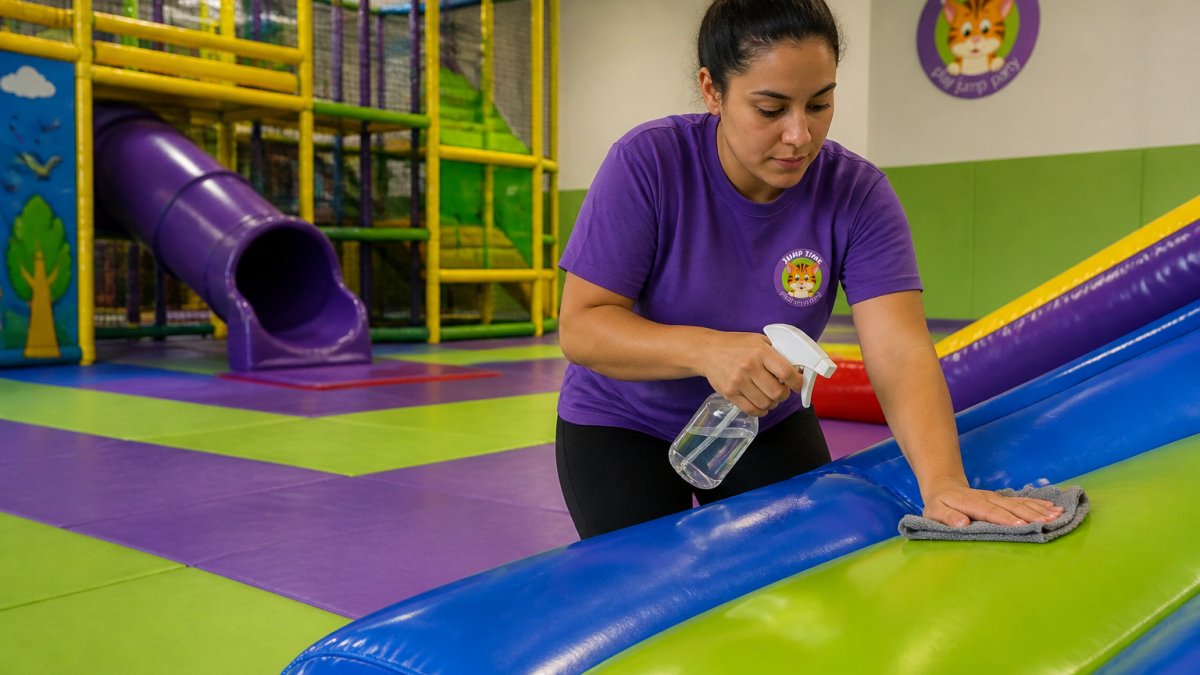
Consistent sanitization of these high-traffic surfaces ensures a hygienic environment, though specialized attention is required when cleaning play mats to preserve their material integrity and safety.
Morning Prep Routine
The morning routine sets the tone for the whole day. A staff member walks every zone before the first guest arrives.
- Wipe down door handles, gates, and check-in counters
- Sanitize tables, chairs, and party room surfaces
- Spot-check the toddler soft play area for debris
- Restock soap, paper towels, and hand sanitizer
- Do a quick safety walk of the inflatables and play structure
End-of-Day Cleaning
Closing time is when the real work happens. Traffic has stopped, so the team can clean without working around kids.
- Mop all floors, including under tables and benches
- Wipe every high-touch surface one more time
- Vacuum or sweep the soft play area
- Empty and sanitize all trash bins
- Log anything that needs a deeper clean the next morning
Building an Indoor Play Equipment Cleaning Schedule That Works
An indoor play equipment cleaning schedule only works if it is written down and posted. Memory fails on busy days.
We group equipment into three tiers based on how often kids touch it.
| Tier | Equipment | Frequency | Who Cleans |
|---|---|---|---|
| 1 | Handrails, gates, tables, arcade buttons | Multiple times daily | Floor staff |
| 2 | Inflatables, slides, play structure | Daily wipe, weekly deep clean | Cleaning crew |
| 3 | Ball pit, soft play mats, party rooms | Weekly deep clean | Cleaning crew |
Tier 1 surfaces get wiped between busy sessions. Tier 2 gets a surface wipe each day and a full scrub weekly. Tier 3 gets a scheduled deep clean.
A common mistake is treating every surface the same. That wastes time on low-touch areas and leaves the busy ones dirty.
Post the schedule where staff can see it, and initial each task as it is done. A visible log keeps everyone honest and shows parents you take cleaning seriously.
Ball Pit Cleaning Frequency: Why It Matters More Than You Think
Ball pit cleaning frequency should be at least once a week for the balls themselves, with a full empty-and-sanitize every month. Ball pits collect more germs than any other zone because kids dive in face-first.
Here is how we handle it:
- Daily: skim the surface for debris, food, and lost items
- Weekly: remove all balls, vacuum the pit floor, wipe the walls
- Monthly: wash every ball in a disinfectant solution and let them air dry
The EPA list of registered disinfectants is the right place to check which products actually kill germs on plastic surfaces. Not every cleaner works on every material.
Drying matters as much as washing. Wet balls grow mold, and mold in a ball pit is a problem no parent forgives.
Indoor Playground Cleaning and Sanitizing: Cleaning vs. Disinfecting
Indoor playground cleaning and sanitizing are not the same thing, and mixing them up leads to dirty equipment that smells like chemicals.
Cleaning removes dirt, dust, and grime with soap and water. Disinfecting kills germs on a surface after it has been cleaned.
The order matters. Disinfectant does not work well on a dirty surface. You clean first, then disinfect.
For most play equipment, a two-step process works best:
- Wipe with soap and water to remove grime
- Apply a child-safe disinfectant and let it sit for the listed contact time
- Wipe dry or let it air dry completely
Contact time is the step most people skip. If the label says the product needs one minute to work, wiping it off after ten seconds does nothing.
Never mix cleaning products. Combining bleach with ammonia-based cleaners creates toxic gas. Use one product at a time and follow the label.
A Complete Cleaning Checklist for Indoor Play Centers
A cleaning checklist for indoor play centers should cover every zone, every day. Here is the one we use as a starting point.
Daily:
- Wipe door handles, gates, and check-in counters
- Sanitize tables and chairs in the eating area
- Mop all floors
- Clean and restock restrooms
- Wipe arcade buttons and screens
- Spot-clean inflatables and slides
Weekly:
- Deep clean inflatables and play structure
- Vacuum and wipe soft play mats
- Clean ball pit walls and skim balls
- Wipe down party room walls and furniture
Monthly:
- Wash all ball pit balls
- Inspect equipment for wear and tears
- Deep clean vents and hard-to-reach areas
- Review and update the schedule
The CDC’s guidance on norovirus prevention in child care settings is a helpful reference for how quickly germs spread in spaces where kids play. It shapes how often we clean during flu season.
Common Cleaning Mistakes Indoor Play Centers Make
The biggest cleaning mistake is cleaning for looks instead of health.
Here are the mistakes we see most:
- Skipping contact time. Disinfectant needs time to work. Rushing it wastes the product.
- Using one cloth everywhere. A single rag spreads germs from the restroom to the play structure.
- Ignoring soft surfaces. Foam mats and fabric absorb spills and need more than a surface wipe.
- Cleaning only when it looks dirty. Germs are invisible. Follow the schedule, not your eyes.
- Forgetting the air. Good ventilation and clean vents matter as much as clean floors.
The fix is simple. Write the schedule, follow it, and log every task.
Centers with high daily traffic and a small staff. A tiered schedule keeps the busiest surfaces clean without burning out the team.
Conclusion: Clean Play Spaces Build Trust
Keeping a play center clean is a daily commitment, not a one-time task. Parents notice. They also notice when everything feels fresh.
At Jump Time, we built our cleaning routine around that trust. Our climate-controlled facility, commercial-grade inflatables, and dedicated toddler soft play area all get the same attention every single day. We also offer 24/7 online booking and waivers, so planning a visit or a party is easy and stress-free.
If you want a clean, safe space for your kids to burn off energy, come see us. Book your visit or party with Jump Time and let the kids play while you relax.
Frequently Asked Questions
How often should indoor play equipment be cleaned?
Indoor play equipment should be wiped down at least twice daily, before opening and after closing, with high-touch surfaces like handrails and slide edges cleaned more frequently during busy hours. A deeper clean of inflatables, play structures, and soft play areas should happen weekly. This indoor play equipment cleaning schedule keeps germs in check without disrupting operations.
How often should ball pits be cleaned?
Ball pit cleaning frequency should be at least weekly for a full ball-by-ball sanitizing, with daily spot checks to remove debris, food, and visibly soiled balls. High-traffic ball pits may need a full clean twice a week. A common method is to vacuum debris, spray balls with a child-safe disinfectant, and let them air dry before returning them. Some centers rotate stock so half the balls are being cleaned while the rest stay in play.
What is the difference between cleaning and sanitizing play equipment?
Cleaning removes visible dirt, crumbs, and oils using soap and water. Sanitizing reduces bacteria to safer levels using a disinfectant or sanitizing spray. Both matter: you cannot effectively sanitize a surface that still has grime on it. For indoor playground cleaning and sanitizing, clean first, then apply a child-safe sanitizer, and let it sit for the contact time listed on the product label before wiping or air drying.
What should be cleaned in an indoor play center every day?
Daily cleaning should cover all high-touch surfaces: handrails, entry gates, party tables and chairs, arcade buttons, restroom fixtures, door handles, and the toddler soft play area. Floors should be swept and mopped, and any inflatable surfaces kids contact most should be wiped down. A written cleaning checklist for indoor play centers helps staff stay consistent, and it gives parents confidence when they see it being followed.
Recent Comments