
Last Updated: October 23, 2026
Quick Summary
To organize community events for kids, start by defining a narrow purpose, target age group, and venue, then build a planning checklist with clear roles and a budget. Recruit a team, plan inclusive activities, and handle permits, insurance, and supervision ratios before promoting. Finish with online registration, a day-of schedule, and a post-event debrief.
- Write a two-sentence purpose naming who the event serves and what kids take away.
- Set supervision ratios by the youngest group: one adult per two to three toddlers.
- Rotate activity stations every 20 to 30 minutes to keep energy up and prevent crowding.
- Post the activity listing two to three weeks out and send a reminder three days before.
- Ask families one question after the event: what would make you come back?
Table of Contents
- Start With Purpose: Define Your Event and Audience
- Build Your Children’s Event Planning Checklist
- Community Event Ideas for Kids That Keep Everyone Busy
- Use a Children’s Event Schedule Template to Plan the Day
- Plan Inclusive Activities for Children of Every Ability
- Handle Permits, Insurance, and Safety Supervision
- Manage Registration, Consent, and Promotion
- Evaluate and Follow Up After the Event
- Frequently Asked Questions
Start With Purpose: Define Your Event and Audience
A clear purpose is what separates smooth community events for kids from stressful ones.
Community events for kids succeed when the goal is narrow. “Fun for everyone” is not a goal.
Ask three questions first:
- What need does this event meet? (Play, connection, a seasonal celebration)
- Who is the audience? (Families, a school, a church group, a neighborhood)
- What does success look like? (Attendance, smiles, repeat interest)
The Centers for Disease Control and Prevention guidance on children’s physical activity notes that active play supports healthy growth and social skills, which gives you a strong reason to build movement into the plan.
Pick the Date, Time, and Venue
Choose a date that avoids school breaks, major holidays, and competing local events. Weekend mornings work well for young families. Check your venue’s calendar early, since popular spaces fill up.
Indoor venues remove weather risk entirely. A climate-controlled space keeps kids comfortable in summer heat and winter cold, and it means you never need a rain plan.
Identify Your Target Age Group
Age range shapes everything: activity choice, schedule length, staffing, and safety rules. Mixing toddlers with eight-year-olds is doable, but it needs separate zones. Pick a primary age band and plan around it.
| Age Group | Session Length | Activity Focus | Supervision Needs |
|---|---|---|---|
| Toddlers (1-3) | 60-90 minutes | Soft play, simple games | One adult per 2-3 kids |
| Preschool (3-5) | 90-120 minutes | Guided games, crafts | One adult per 4-5 kids |
| Early elementary (5-8) | 2 hours | Active play, team games | One adult per 6-8 kids |
| Mixed ages | 2 hours | Zoned stations | Ratio set by youngest group |
Build Your Children’s Event Planning Checklist
A children’s event planning checklist turns a big idea into small, finishable tasks. Build it in a shared document so your team can see progress at a glance. Work backward from the event date and assign a deadline to every line.
Here is a starter checklist you can copy:
- Confirm purpose, audience, and age range
- Lock the date, time, and venue
- Set the budget and identify funding sources
Recruit a Planning Team and Delegate Tasks
One person cannot run a children’s event alone. Recruit a small committee and give each member a clear area of ownership. Delegation works best when roles are specific.
Common roles:
- Event lead: keeps the timeline and makes final calls
- Activities coordinator: sources games, entertainment, and supplies
- Safety lead: handles supervision plans and first aid
Assign one person to be the single point of contact for the venue. Too many cooks calling the facility creates confusion and missed details.
Set a Budget and Find Funding
Write your budget before you spend a dollar. List every cost line, then list every possible funding source. This is the part most volunteer planners skip, and it is where events quietly fall apart.
Cost lines to include:
- Venue rental
- Food and drinks
- Supplies and decorations
Funding options include ticket or entry fees, local business sponsorships, a school or church budget line, and small community grants. Keep a cushion for surprises. Pricing at indoor venues varies by package, group size, and date, so request a quote early and confirm what is included.
Community Event Ideas for Kids That Keep Everyone Busy
The best community event ideas for kids mix active play with calmer options so every child finds something to do. Plan more activities than you think you need. Downtime is where chaos starts.
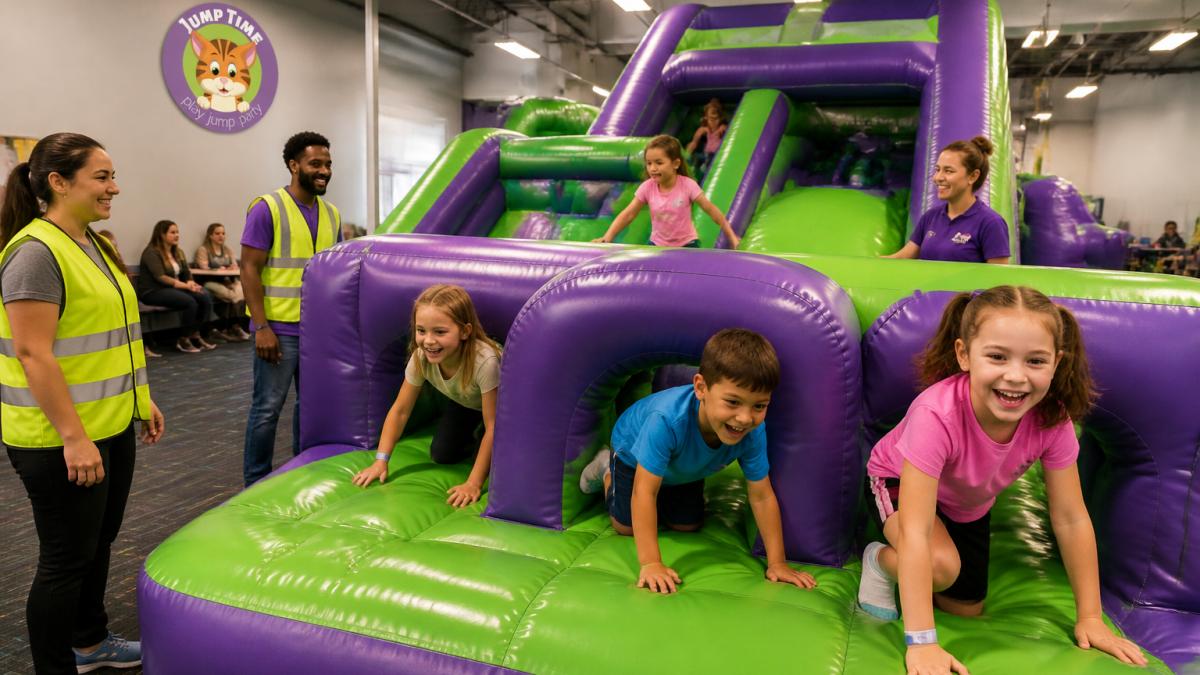
Try these crowd-pleasers:
- Inflatable obstacle courses and slides for high-energy kids
- Toddler soft play zones for the youngest guests
- Relay races and parachute games for groups
Rotate stations every 20-30 minutes. Movement between zones keeps energy up and prevents any one area from getting crowded.
Use a Children’s Event Schedule Template to Plan the Day
A children’s event schedule template is a minute-by-minute plan for the event day. Build it as a simple table with time, activity, location, and the person in charge. Share it with every volunteer before the event.
Sample two-hour schedule:
| Time | Activity | Location | Lead |
|---|---|---|---|
| 9:00 | Check-in and waivers | Front desk | Registration lead |
| 9:15 | Welcome and rules | Main floor | Event lead |
| 9:30 | Open play rotation | Zones A-C | Activities team |
| 10:15 | Snack break | Party room | Food lead |
| 10:35 | Group games | Main floor | Activities lead |
| 11:00 | Wind-down and pickup | Front desk | All staff |
Post the schedule where volunteers can see it. Build in buffer time. Nothing runs exactly on time with young kids.
Plan Inclusive Activities for Children of Every Ability
Inclusive activities for children mean every child can take part, not just watch from the sidelines. Ask families about needs at registration. Offer a quiet space for kids who need a break from noise.
Simple inclusion moves:
- Provide seated versions of active games
- Use visual instructions alongside spoken ones
- Keep pathways wide for wheelchairs and strollers
The Americans with Disabilities Act guidance on accessible public accommodations sets the baseline for accessibility. Go beyond the minimum where you can. A calm corner and clear signage cost little and help a lot.
Handle Permits, Insurance, and Safety Supervision
Safety planning is not optional when children are involved, and the paperwork side is where volunteer organizers most often get caught short. Treat permits, insurance, and supervision as one connected workstream led by a single safety lead who reports to the event lead. Establishing these rigorous protocols early creates a reliable framework that remains equally essential when you organize a child’s birthday in a public space.
Confirm permits before you promote
Start with your venue. Ask in writing which permits the facility already holds and which the event must obtain separately. A community room, school gym, church hall, and private play center each carry different obligations, and the answer changes based on whether your event is open to the public, ticketed, or limited to invited families.
Common permit and approval categories to ask about:
- Temporary food service if you will prepare, cook, or sell food rather than hand out sealed snacks
- Fire and occupancy limits for the room or building, including posted capacity and exit access
- Street or park use if any part of the event spills outdoors
Call the relevant local office and ask two questions: does this event type require a permit, and what is the application lead time? Many jurisdictions publish checklists online, and lead times can run several weeks, so start this step as soon as the date is locked. Get every approval in writing and keep copies in a shared folder.
Arrange insurance and understand what it covers
Ask your sponsoring organization, school, church, or venue whether your event is covered under an existing general liability policy and whether volunteers are included. If you need separate coverage, a special-event liability policy is the common route; request quotes early because underwriting questions about inflatables, food, and expected attendance take time to answer.
Confirm in writing:
- The policy limit and the event date and location it names
- Whether volunteers and the venue are additional insureds
- Whether inflatables, arcade equipment, or food service are excluded
An inflatable or amusement device may require the operator to show proof of insurance and an inspection record. Ask the vendor for both before signing, and confirm the venue accepts them.
Run a written risk assessment
A risk assessment is a short table, not a binder. Walk the space before the event and list each hazard, who it affects, the likelihood and severity, and the control you will put in place. Review it with the safety lead and update it after setup.
| Hazard | Who is at risk | Control |
|---|---|---|
| Crowding at entry | All ages | Staggered arrival times, separate check-in line |
| Inflatable entry and exit | Young children | Posted height and age rules, one attendant per device |
| Food allergens | Allergic children | Ingredient labels, nut-free zone, trained staff |
| Lost child | Toddlers and preschoolers | Wristbands with guardian phone, single exit |
| Slips near drinks | All ages | Absorbent mats, spill kit, monitored refill station |
Set supervision ratios and a check-in system
Ratios should be set by the youngest group present, not the average age. A common pattern is one adult per two to three toddlers, one per four to five preschoolers, and one per six to eight early elementary kids, with tighter coverage around water, inflatables, and exits.
Supervision rules that work:
- Assign named volunteers to fixed zones and post the zone map
- Require check-in and check-out by a listed guardian, matched to a wristband number
- Keep a stocked first-aid station with a trained lead and a written incident log
Write a one-page emergency plan covering fire evacuation, severe weather shelter, a missing child, and a medical emergency. Print it for every zone lead and walk the exits with your team during setup.
Safeguarding and inclusion belong in the safety plan
Child protection is part of safety, not a separate topic. Require volunteers who will be alone with children to complete a background check where your organization allows it, keep two adults present at changing and restroom escort points, and set a no-photography rule in restrooms and quiet areas. The Americans with Disabilities Act guidance on accessible public accommodations sets the accessibility baseline; build beyond it where you can.
Manage Registration, Consent, and Promotion
Registration does three jobs: it gives you a headcount, captures consent, and collects emergency contacts. Use one simple form and keep it short.
Include on every form:
- Child’s name and age
- Guardian name and phone number
- Emergency contact
Promote through the channels your families already use: school newsletters, church bulletins, neighborhood groups, and social media. Post the activity listing two to three weeks out, then send a reminder three days before.
Collect waivers online before the event. A digital form means faster check-in and no paper pile at the door.
Evaluate and Follow Up After the Event
The event is not finished when the last family leaves. A short debrief captures what worked while it is fresh. Send a thank-you to volunteers within a week.
Track these numbers:
- Total attendance versus sign-ups
- No-show rate
- Volunteer hours logged
Ask families one question: “What would make you come back?” Their answers shape your next event more than any planning meeting.
At Jump Time, we host group events, field trips, and private parties in our climate-controlled indoor play center, with four party rooms, inflatables, an indoor play structure, and a dedicated toddler soft play area. Online waivers and 24/7 booking keep the paperwork simple. Our team can help you plan a group visit that fits your age range and headcount. Get started with Jump Time and give your community a day the kids will talk about for weeks.
Frequently Asked Questions
How do you make a children’s event safe and inclusive?
Start with a risk assessment that covers supervision ratios, first aid, and allergy management, then set clear behavior expectations before the event. For inclusion, offer quiet spaces for children who get overwhelmed, plan activities at different difficulty levels, and ask families about accessibility needs during registration. Assign one adult to every 6-8 children depending on age, brief volunteers on emergency procedures, and keep a signed consent form for each child. These steps make community events for kids safer and more welcoming for every family.
How long should a community event for kids last?
Most community events for kids work best at 2-3 hours for ages 3-6 and 3-4 hours for ages 7-12, because attention spans and energy drop after that. Build the children’s event schedule template with short activity blocks of 20-30 minutes, a snack break in the middle, and a calm wind-down at the end. If you plan a longer festival, include rest areas and flexible drop-in activities so families can come and go without missing the main program.
What are the 5 C’s in event planning?
The 5 C’s are concept, coordination, cost, communication, and contingency. Concept means defining the event purpose and age group. Coordination covers your planning team and task delegation. Cost means setting a budget and tracking spending. Communication includes promotion, registration, and clear instructions for families. Contingency is your backup plan for weather, low attendance, or equipment failure. Running your children’s event planning checklist against these five areas catches gaps before they become day-of problems.
How do you get families involved in a community event?
Promote through the channels families already use: school newsletters, church bulletins, neighborhood social media groups, and local community boards. Open registration early with a simple online form, and ask parents to volunteer for short shifts rather than the whole event. Offering inclusive activities for children and a clear schedule helps parents decide quickly. After the event, send a short survey and share photos to build momentum for the next one.

Recent Comments