
Table of Contents
- How Active Play Builds Strong Bodies and Brains
- Physical Activity Guidelines for Preschoolers: How Much Is Enough?
- Gross Motor Skills Activities for Toddlers: Balance, Coordination, and Confidence
- Indoor Active Play for Kids: Ideas for Small Spaces and Rainy Days
- The Social and Emotional Benefits of Play
- Safety, Supervision, and Inclusive Adaptations
- Conclusion
- Frequently Asked Questions
Last Updated: October 8, 2026
How Active Play Builds Strong Bodies and Brains
The benefits of active play for young children reach far beyond burning off afternoon energy. Active play is any physical activity children choose for fun, from crawling through a play structure to chasing bubbles across a lawn, and it simultaneously builds muscles, bones, and brain circuits. This guide from Jump Time, our family-owned indoor play center in Villa Rica, breaks down what the research says and how to put it into practice.
Here’s what most parents never hear: the body and the brain develop together, and the link is mechanical, not metaphorical. When a toddler climbs, jumps, or balances, three things happen at once. First, weight-bearing movement loads the long bones and large muscle groups, which signals the body to lay down bone density and build strength. Second, the same movement floods the brain with oxygenated blood and triggers the release of growth factors that support new neural connections. Third, the child is solving a real problem in real time, how to get a foot onto that ledge, how to keep balance while reaching, and that problem-solving is what wires attention, memory, and planning circuits.
Why the Effect Changes With Age
The mechanism is the same at every age, but what it looks like changes fast:
- Infants (0-12 months): Tummy time, reaching, rolling, and crawling build the core and shoulder stability that later make sitting, standing, and walking possible. Floor time is the workout.
- Toddlers (1-2 years): Walking, climbing low steps, pushing and pulling, and squatting to pick things up build leg strength and the motor planning that coordinates two sides of the body.
- Preschoolers (3-5 years): Running, jumping, hopping, throwing, and pedaling build endurance, bone density, and the physical literacy, the confidence and competence to keep moving, that predicts activity levels later in life.
What This Means for You
You do not need a structured program. The mechanical load of bearing their own body weight is what drives bone strength, and short bursts of running and jumping build heart and lung capacity without any formal exercise plan. What matters is frequency and variety: many small bouts of movement across the day, in different directions and at different speeds, give the body and brain more to work with than one long session. If your child is breathing harder, smiling, and choosing to keep going, the mechanism is already running.
Physical Activity Guidelines for Preschoolers: How Much Is Enough?
The widely cited benchmark is at least 180 minutes of physical activity per day for children ages 3 to 5, spread across the day, with at least 60 minutes of it being energetic play. For children ages 1 to 2, the guidance is at least 180 minutes daily of activity of any intensity, including active play.
These numbers sound intimidating until you break them down. Three hours is not three hours of calisthenics. It is the accumulation of walking to the car, dancing to a song, climbing at the playground, and helping carry groceries. The goal is to reduce sedentary time and build movement into ordinary routines rather than schedule a formal workout.
A simple way to measure progress is to think in blocks:
|
Time Block |
Realistic Activity |
Minutes |
|---|---|---|
|
Morning |
Dressing, dancing to music, walking to the car |
30-40 |
|
Midday |
Playground, indoor play center, or backyard time |
60-90 |
|
Afternoon |
Chores, active games, sibling play |
30-40 |
|
Evening |
Family walk, wind-down movement |
20-30 |
For toddlers specifically, the American Academy of Pediatrics guidance on active play emphasizes free, unstructured movement over structured exercise. If a child is moving, breathing harder, and smiling, they are hitting the mark.
Gross Motor Skills Activities for Toddlers: Balance, Coordination, and Confidence
Gross motor skills are the large-muscle movements that let a child walk, run, jump, climb, and throw, and they develop fastest through practice, not instruction. Building these skills early supports balance, coordination, and physical literacy, which is the confidence and competence to keep moving throughout life.
Try these activities, most of which need little or no equipment:
- Balance walks: Lay a strip of painter’s tape on the floor and have your toddler walk it heel-to-toe.
- Obstacle courses: Line up cushions, a low stool, and a hula hoop to crawl, step, and jump through.
- Ball rolling and tossing: Start with a large soft ball to build coordination and hand-eye tracking.
- Stair climbing: Supervised stair practice builds leg strength and motor planning.
- Dance and freeze: Music games build coordination, listening, and body awareness at once.
The thing nobody tells you about gross motor skills is that confidence matters as much as ability. A child who feels safe trying a new climb will attempt it again, and each attempt refines the skill. That is why age-appropriate challenges, not harder ones, produce the fastest progress.
Indoor Active Play for Kids: Ideas for Small Spaces and Rainy Days
Indoor active play keeps children moving when weather, heat, or air quality makes outdoor time impractical. A hallway, a cleared living room, or a dedicated indoor play center can all support the same physical development that outdoor play does.
For small spaces, the trick is vertical and low-equipment movement:
- Hallway races: Bear crawls, crab walks, and hopping races down the hall.
- Balloon volleyball: Keep a balloon off the floor using hands and feet.
- Pillow forts and tunnels: Crawling and climbing build core and shoulder strength.
- Indoor obstacle courses: Cushions, tape lines, and a laundry basket to jump into.
- Toddler soft play: Soft blocks and mats let the youngest children climb and tumble safely.
At Jump Time, our climate-controlled facility was built for exactly this. We offer bounce houses, obstacle courses, inflatable slides, an indoor play structure, and a toddler soft play area, plus an arcade and a full kitchen on site. Our All-Day Access pass means you can come and go as you like, so a nap or a meal break doesn’t end the fun. Head Start’s early childhood learning guidance also stresses that daily movement matters in every setting, indoor or out.
The Social and Emotional Benefits of Play
Active play is one of the most effective tools for social and emotional development in early childhood. Group play teaches children to share, take turns, negotiate rules, and read other people’s feelings, all of which build peer interaction skills and emotional well-being. Providing children with Montessori toys encourages this independent exploration and cooperative engagement, fostering a deeper sense of confidence during their formative social experiences.
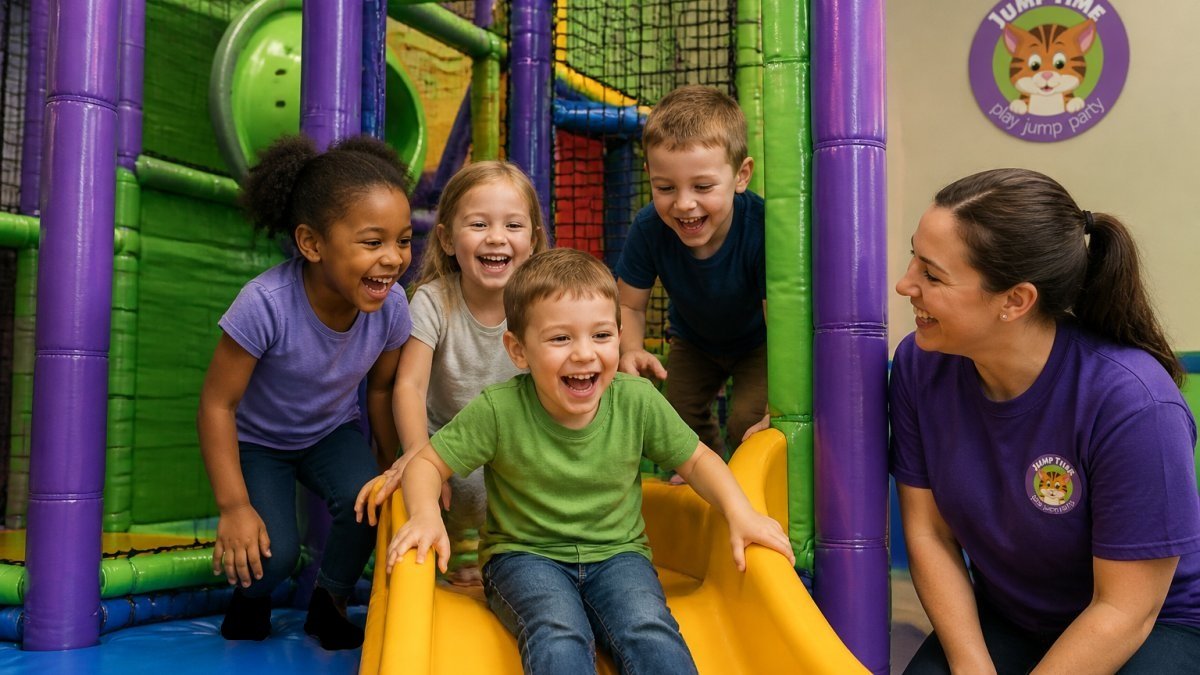
A group of young children laughing and playing together on a colorful indoor play structure, with a caregiver watching warmly from the side
The emotional payoff runs deeper than good manners. Physical activity releases feel-good chemicals in the brain, and regular movement is associated with lower rates of anxiety and depression risk in children. Play also gives children a safe outlet for big feelings, and the caregiver bonding that happens during play strengthens relationships that support long-term mental health.
What Each Age Is Actually Practicing
Social skills do not appear all at once; they are built in sequence, and the type of play that helps changes with the child:
- Toddlers (1-2 years): Mostly parallel play, sitting near another child, doing the same thing, without much interaction. This is not a failure to share; it is the foundation. They are learning that other children exist and are safe.
- Young preschoolers (3-4 years): Associative play, trading toys, copying each other, brief back-and-forth. Turn-taking is still shaky, and that is normal.
- Older preschoolers (4-5 years): Cooperative play, agreeing on rules, assigning roles, negotiating who is the doctor and who is the patient. This is where real peer interaction and emotional regulation get practiced.
How to Support It Without Taking Over
Most practitioners find that the adult’s job is to set the stage and then step back. A few strategies that work:
- Join briefly, then exit. Get down on the floor, follow your child’s lead for a minute or two, then drift to the edge. Children sustain play longer when an adult is nearby but not directing.
- Narrate feelings, not behavior. “You look frustrated that the tower fell” gives a child language for emotion, which is the first step toward managing it.
- Choose cooperative games over competitive ones. A game where kids have to work together to move a ball across a room builds more peer interaction than a race with a single winner.
- Protect unstructured time. Free play, where children choose what to do and how, is where negotiation and creativity actually happen. Structured activities have their place, but they do not replace it.
- Let boredom happen. The pause before a child invents a game is not wasted time; it is the moment problem-solving and self-regulation get exercised.
Safety, Supervision, and Inclusive Adaptations
Safe active play comes down to three things: age-appropriate equipment, active supervision, and a space that adapts to every child’s needs. Most play injuries are preventable with the right setup and a watchful adult nearby.
A common mistake is assuming that a bigger, more crowded space is automatically better. In practice, younger children do best in a defined area with soft surfaces and equipment sized for them, while older kids need room to run and climb. Supervision should be active, meaning an adult is watching and within reach, not just present. For children with sensory sensitivities or physical limitations, look for quieter corners, softer lighting, and equipment that can be used at a child’s own pace.
Conclusion
Keeping young children active every day takes planning, especially when weather, small spaces, or busy schedules get in the way. At Jump Time, we make it easy with a clean, climate-controlled indoor facility, commercial-grade equipment, a dedicated toddler soft play area, and All-Day Access so families can come and go as they please. Our team also handles birthday parties and group events with online booking and waivers available around the clock. Get started with Jump Time and give your kids a safe, active place to play all year long.
Frequently Asked Questions
What are the benefits of active play for children?
Active play supports physical development like muscle strength, bone strength, and endurance, and it also builds gross motor skills such as balance and coordination. Beyond the body, it strengthens attention, memory, and problem-solving, and it gives children daily practice with peer interaction, turn-taking, and handling big feelings. The benefits show up across physical, cognitive, social, and emotional development at the same time.
How much physical activity do young children need each day?
A common guideline for preschoolers is at least 180 minutes of physical activity spread across the day, with at least 60 minutes of that being energetic, structured movement. Toddlers need a similar daily total, broken into short bursts rather than one long session. Three 20-minute play blocks usually work better for young children than a single hour.
What are some indoor active play ideas for young children?
Try obstacle courses with cushions and painter’s tape, balloon volleyball, freeze dance, indoor hopscotch, and hallway bowling with plastic bottles. For toddlers, a soft play area with climbing blocks and tunnels builds gross motor skills without much setup. Rotating a few of these keeps the variety of movement wide and the routine easy to repeat.
How does active play support social and emotional development?
Group play gives young children repeated chances to share, negotiate, take turns, and read other kids’ faces and body language. Those moments build peer interaction skills and caregiver bonding, and they offer a safe outlet for frustration and excitement. Children who play actively with others most days tend to show stronger emotional well-being and better self-regulation over time.
Recent Comments