
Table of Contents
- Indoor Play Areas for Toddlers in Villa Rica: A Local Guide
- Jump Time: Family-Owned Active Play and Soft Play for Young Children
- Safe Indoor Play for Toddlers: What to Expect
- Toddler Soft Play Area: Dedicated Spaces for Your Youngest
- Indoor Playground for Toddlers: Activities and Play Options
- Things to Do with Toddlers Indoors: Beyond Just Play
- Planning Your Visit: Practical Details for Families
- Conclusion: Year-Round Indoor Fun for Your Toddler
- Frequently Asked Questions
Last Updated: October 19, 2026
Indoor Play Areas for Toddlers in Villa Rica: A Local Guide
Finding the right indoor play space for your toddler isn’t just about a rainy-day distraction. If you’re searching for indoor play areas for toddlers in Villa Rica, you want safety, cleanliness, and age-appropriate activities, not a chaotic space where kids run wild.
At Jump Time, a family-owned indoor play center in Villa Rica, we’ve spent years creating dedicated spaces where toddlers thrive, whether you need a regular activity spot, a field trip destination, or a birthday venue.
This guide covers what makes a quality indoor play space, our dedicated soft play areas, and practical visit-planning details for children and caregivers.
Jump Time: Family-Owned Active Play and Soft Play for Young Children
Jump Time is your local destination for indoor play in Villa Rica. Our family-owned, climate-controlled facility stays open year-round, so families always have a safe place to play when the outdoors isn’t an option.
What sets us apart is quality equipment and a genuinely welcoming environment. Every piece meets commercial-grade standards, and we maintain rigorous cleanliness protocols, our team cleans and sanitizes between every session, including after birthday parties.
What Makes Jump Time Different
Parents often compare us to bigger chains. We’re locally owned, not a corporate facility answering to shareholders in another state, we’re your neighbors, and your child’s experience reflects directly on us.
Our commercial-grade equipment matters for safety and durability.
We also offer genuine flexibility: our 24/7 online booking and waiver system lets you book a visit or party at your convenience.
Facilities and Equipment
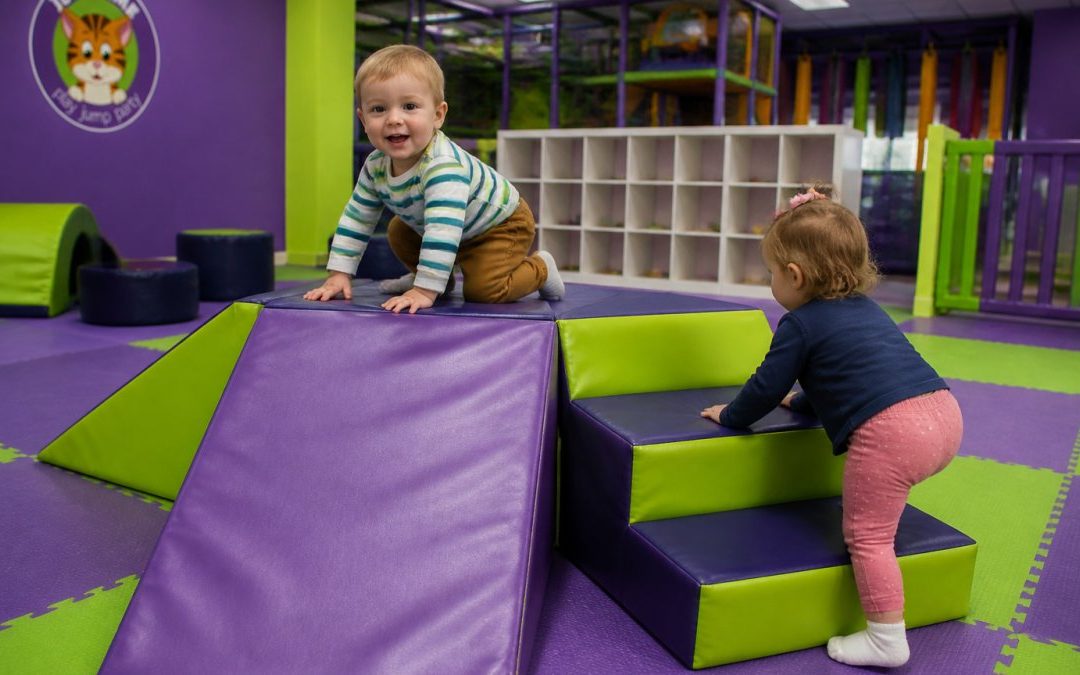
Our facility includes bounce houses, obstacle courses, inflatable slides, and an indoor play structure. For toddlers, we’ve designed dedicated soft play areas with padded equipment, lower heights, and slower-paced activities, nothing overwhelming or beyond their coordination.
We operate four party rooms, each seating up to 35 people, and open jump sessions run throughout the week for families who want a break from the weather or structured active play.
If your toddler is new to structured play environments, arrive 15 minutes early on your first visit. This gives them time to acclimate to the space without feeling rushed. Most toddlers warm up quickly once they see other kids having fun.
Safe Indoor Play for Toddlers: What to Expect
When evaluating any indoor play area for toddlers, safety is your first filter: age-appropriate equipment, supervision practices, and injury procedures.
At Jump Time, our toddler soft play areas are designed around what young children can safely do.
Supervision matters enormously. Our staff actively watches the play areas, parents stay with their children during open jump sessions, and team members are present throughout parties to ensure safety.
Never assume a facility is safe just because it looks clean. Ask specific questions: How often is equipment inspected? What’s the staff-to-child ratio? Do they have incident procedures? Facilities that answer these questions directly are the ones taking safety seriously.
Toddler Soft Play Area: Dedicated Spaces for Your Youngest
The toddler soft play area gives younger children (typically ages 1-3) their own space designed specifically for their developmental stage, a genuine difference in how the space is set up.
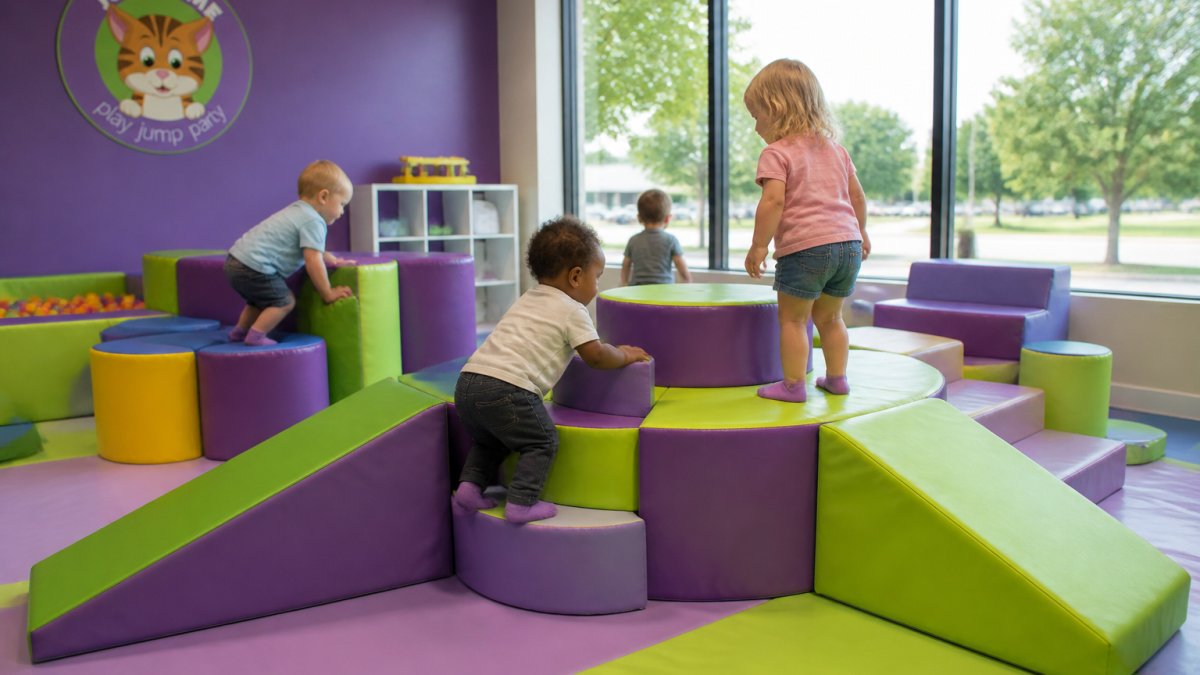
Soft play equipment includes padded climbing structures, foam blocks, tunnels, gentle slides, and ball pits with appropriate ball sizes.
Many parents worry their toddler will be bored in a dedicated soft play area, the opposite is true.
Indoor Playground for Toddlers: Activities and Play Options
An indoor playground for toddlers isn’t one experience, it’s a menu. The right venue lets you match activity to your child’s developmental stage, sensory tolerance, and energy level.
Match the Activity to the Developmental Stage
A 14-month-old and a 34-month-old need very different play. Use this as a rough guide:
- New walkers (roughly 12-18 months): Look for flat, padded floor space, low foam blocks to stack and knock over, and shallow ball pits with larger balls. Avoid tall climbing structures and anything requiring a step up higher than knee height.
- Confident walkers (roughly 18-24 months): Gentle slopes, low tunnels to crawl through, small slides with a short run-out, and soft climbing mounds. These build balance and confidence without a big drop.
- Runners and climbers (roughly 24-36 months): Low obstacle courses, padded steps, balance beams close to the floor, and small inflatable slides with soft landings. This is the age where variety matters most, toddlers this age switch activities every few minutes.
If a venue’s toddler zone is one undifferentiated padded room, it will hold a new walker’s attention but bore a 3-year-old. The best toddler areas have at least three distinct sub-zones so kids can rotate.
The Main Activity Types and What They Build
| Activity type | What it develops | Best for |
|---|---|---|
| Soft climbing structures | Gross motor skills, balance, confidence | 18 months+ |
| Foam blocks and stacking | Fine motor skills, cause-and-effect | 12 months+ |
| Crawl tunnels | Spatial awareness, gross motor | 12-30 months |
| Gentle slides | Balance, turn-taking, bravery | 18 months+ |
| Ball pits (large balls) | Sensory input, scooping and pouring | 12 months+ |
| Low obstacle courses | Coordination, sequencing | 24 months+ |
| Cause-and-effect play panels | Problem-solving, fine motor | 12 months+ |
A good toddler session touches several categories: a toddler who only climbs misses fine-motor and sensory play, while one who only does table play misses the gross-motor work that tires them out before nap time.
Sensory Considerations
Some toddlers seek movement and noise; others are overwhelmed by it. A toddler-friendly venue should offer both:
- Active zones with climbing, sliding, and bouncing for sensory seekers.
- Quiet corners with soft seating, books, or low-stimulation play for toddlers who need to regroup.
If your toddler is sensory-sensitive, visit during a quieter session, weekday mornings are typically calmer than weekend afternoons. Ask staff whether music and announcements can be turned down, and whether there’s a designated quiet space away from the main play floor.
The best indoor playground for a toddler is the one that lets you change zones when attention drifts. Variety isn’t a luxury, it’s how toddlers stay engaged, build different skills, and avoid the overstimulation that ends a visit early.
Energy-Level Matching
Not every visit is a burn-off-energy visit. Look for a mix of high-energy zones (climbing, slides, obstacle courses) and low-energy zones (blocks, play panels, quiet corners) so you can read your child’s mood and steer accordingly.
What to Skip
If a venue’s toddler offering is limited to a small corner of a general play floor shared with older kids, it’s not a dedicated toddler area, it’s a compromise. Toddlers do best when they have their own space with equipment sized to them, separate from older children whose speed and size create collision risk. Ask specifically: Is the toddler area physically separated from the older-kid zones? The answer tells you more than any marketing photo.
Things to Do with Toddlers Indoors: Beyond Just Play
Active play is our core, but we’ve designed our facility with caregivers in mind, not just children.
Our full kitchen means you can purchase snacks without leaving the facility, one less thing to coordinate, and one more reason a birthday party is actually enjoyable to host.
Not every visit is about running around.
For school groups, we offer structured field trip options where kids burn energy safely while developing social skills and coordination. We handle the logistics; you handle the learning objectives.
Planning Your Visit: Practical Details for Families
What parents actually need is a visit plan: how far you’ll drive, what to pack, how long a toddler will last, and what the facility offers caregivers once inside.
Drive Time and Arrival Planning
Villa Rica sits at the crossroads of Interstate 20 and U.S. Highway 78, a realistic meet-up point for families from the surrounding areas. Check drive time at the hour you’d actually travel, a 20-minute drive at 10 a.m. can become 35 during the evening commute.
If coordinating with another family, meet 10-15 minutes before the session so toddlers acclimate together, and use the extra time to finish waivers and check-in without a line behind you.
What to Bring (and What to Leave in the Car)
- Grip socks or indoor shoes for every child and adult who will be on the play floor. Many facilities require them; call ahead if you’re unsure.
- A refillable water bottle per toddler. Active play dehydrates kids faster than parents expect.
- A change of clothes for toddlers still in pull-ups or newly potty-trained, accidents happen, and a spare set prevents an early exit.
How Long a Toddler Actually Lasts
A realistic window for toddlers ages 1-3 is 60 to 90 minutes of active play before fatigue, hunger, or overstimulation sets in. Plan around that window rather than an all-afternoon outing, and schedule the toddler-friendly block early at mixed-age parties, before older kids dominate the floor.
Amenities Caregivers Should Confirm Before Booking
Ask any venue these questions directly, the answers separate a toddler-friendly facility from a general recreation center:
- Seating with sightlines. Can you sit and still see your toddler in the soft play zone? Good facilities design caregiver seating around the toddler area, not off to the side.
- Restrooms with changing tables. Confirm there’s a changing station in both the men’s and women’s restrooms, not just one.
- Food and drink policy. Some venues allow outside food; others have a kitchen on site. Knowing this ahead of time prevents a hungry-toddler meltdown.
- Stroller access. Is there a ramp or elevator, or only stairs? Is there a designated stroller parking area?
- Sensory considerations. Ask whether there are quieter corners, whether music and announcements are kept at moderate volume, and whether lighting is adjustable. Sensory-sensitive toddlers do better when a venue can dial down stimulation.
- Accessibility. Confirm wheelchair and mobility-device access to the play floor and restrooms if a grandparent or caregiver with mobility needs is joining.
Call the venue during a weekday morning rather than a weekend afternoon. You’ll reach a staff member who isn’t managing a party, and you’ll get more detailed answers about toddler zones, cleaning schedules, and capacity limits.
Booking and Waivers
Online booking and digital waivers save time at the door. Fill out the waiver once per child and save the confirmation email, most systems store it for future visits. For a party, ask about the cancellation window and whether room time includes setup and cleanup.
A Sample Toddler Visit Timeline
| Time | Action |
|---|---|
| 15 min before session | Arrive, park, check in, complete waiver if needed |
| Session start | Enter soft play zone, let toddler observe for 5 minutes |
| +15 min | Move to a second activity zone (tunnel, ball pit, gentle slide) |
| +45 min | Water break and snack at caregiver seating |
| +60-75 min | Final play block, then wind down |
| +90 min | Exit before overtired meltdown |
This timeline is a starting point, not a rule. Watch your toddler’s cues, eye-rubbing, clinging, or refusing to change zones usually means it’s time to go.
Conclusion: Year-Round Indoor Fun for Your Toddler
Finding the right indoor play area for your toddler comes down to three things: safety, cleanliness, and genuine engagement, a place where you trust the staff and equipment and the experience is worth your time.
Jump Time brings all three together. As a family-owned facility in Villa Rica, we’ve built our reputation on quality equipment, rigorous cleanliness standards, and a welcoming environment, with dedicated soft play areas, a climate-controlled facility, and 24/7 online booking for year-round indoor play.
Frequently Asked Questions
Are indoor play areas safe for toddlers?
Yes, when facilities maintain high standards. Look for venues with commercial-grade equipment, regular cleaning and sanitization, trained staff supervision, and dedicated toddler zones with age-appropriate structures. Jump Time prioritizes safety with climate-controlled spaces and equipment designed for active play. Always check that the facility follows health and safety protocols and ask about their cleaning schedule.
What should I look for in an indoor play area for toddlers?
Choose venues with separate toddler soft play areas, clean and well-maintained equipment, qualified staff, climate control, and reasonable supervision ratios. Consider proximity to your location, available amenities like restrooms and seating for caregivers, and whether the facility offers both open play and structured activities. Check reviews from other parents and visit during quieter hours to assess the environment before bringing your toddler.
Does Jump Time in Villa Rica have a toddler soft play area?
Yes. Jump Time features a dedicated toddler soft play area designed specifically for your youngest guests, alongside bounce houses, obstacle courses, and inflatable slides. The facility is family-owned and climate-controlled, making it a year-round option for toddler play. Visit Jump Time’s website or contact them directly to learn about open play hours and current offerings.
What should I bring to an indoor play center with a toddler?
Bring extra clothes in case of spills or sweating, socks (most facilities require them), diapers and wipes, snacks, water, and any comfort items your toddler needs. Pack a small bag with a change of clothes and consider bringing hand sanitizer. Check the facility’s policies on outside food and drinks ahead of time. Wear comfortable shoes for yourself so you can move easily while supervising.
Book a party or plan your first open jump visit with Jump Time. See firsthand why families in Villa Rica choose us for safe, engaging indoor play.
Recent Comments