
Table of Contents
- How to Host Kids Parties on a Budget: 7-Step Plan
- Kids Birthday Party Budget Checklist
- Cheap Kids Birthday Party Ideas That Still Feel Special
- Budget-Friendly Kids Party Food Ideas
- How Long Should a Kids Birthday Party Last?
- Choosing a Free or Low-Cost Venue: Home, Park, or Indoor Center
- Conclusion: Stress Less, Celebrate More
- Frequently Asked Questions
Last Updated: October 8, 2026
How to Host Kids Parties on a Budget: 7-Step Plan
Learning how to host kids parties on a budget comes down to one idea: spend where kids actually notice, and save everywhere else.
Here is the 7-step plan we recommend:
- Set a total budget and a cost per guest before you buy anything
- Pick a simple theme you can build with items you own
- Trim the guest list to a number you can host comfortably
- Choose a free or low-cost venue
- Plan two or three easy games, not ten
- Serve simple food and a homemade cake
- Assemble low-cost party bags at the end
Most blowouts happen because parents plan the party first and add up costs later. Reverse that order and you stay in control.
Set a hard cost per guest first. If your budget is $150 and you invite 15 kids, that is $10 per child for everything: food, favors, cake, and activities. Every decision after that is just math.
Kids Birthday Party Budget Checklist
A kids birthday party budget checklist keeps you from discovering hidden costs the week of the party. The goal is not to spend the least, it is to know where every dollar goes before you spend it.
Use this checklist before you spend a dollar:
- Total budget written down
- Guest count confirmed with RSVPs
- Cost per guest calculated
- Venue cost (or $0 for home or park)
That last line matters. A 15% buffer on a $150 party is $22.50, enough to absorb a forgotten bag of ice or one extra guest.
Track your spending in a notes app as you buy, not after. By the time you are three receipts in, the mental math stops working.
Sample Itemized Budget for 10 Kids
Here is a realistic itemized plan for a 10-child at-home party. Numbers reflect typical grocery and discount-store pricing and will vary by region and season.
| Item | Low End | Mid Range | Notes |
|---|---|---|---|
| Invitations | $0 | $8 | Free digital invites vs. printed cards |
| Food and drinks | $35 | $55 | Snacks, not a full meal |
| Cake (homemade) | $12 | $22 | Box mix, frosting, candles |
| Decorations | $8 | $18 | Reuse what you own; buy one focal item |
| Games and prizes | $8 | $15 | Mostly household items |
| Party bags | $12 | $25 | 3-4 small items per bag |
| Paper goods | $6 | $12 | Plates, cups, napkins, utensils |
| Buffer (15%) | $12 | $23 | Forgot-something fund |
| Total | $93 | $178 | $9-$18 per child |
That works out to roughly $9 to $18 per child. If your budget is $150 for 10 kids, you have $15 per child, and the table above shows exactly where that money can go.
Cost-Per-Child Math for Venues, Food, and Favors
Cost per child is the single most useful number in party planning because it lets you compare options that look nothing alike. A $300 venue package for 15 kids is $20 per child; a $150 home party for 10 kids is $15 per child. The venue is not automatically the expensive choice, it depends on how many kids you invite.
Run the same math on the three biggest line items:
- Venue: total package cost ÷ guest count. A venue that includes food, cake, and activities may beat a home party once you add up your own grocery and supply runs.
- Food: total food spend ÷ guest count. Snack-only menus typically land around $3 to $5 per child; a full meal can double or triple that.
- Favors: total favor spend ÷ guest count. A $2-per-child bag feels generous; a $6-per-child bag quietly becomes one of your largest costs.
Before you commit to any venue or menu, divide the total by the number of kids. If the per-child number is above your target, cut the guest list before you cut the fun.
Budget Adjustments by Party Size and Age Group
Party size changes your math more than anything else. Ten kids at home is manageable.
For toddlers (ages 1-3), invite fewer children and expect parents to stay.
For ages 4-7, this is peak party size. Games and activities carry the party, so shift budget there and keep favors simple.
For ages 8-12, kids want an experience, not goody bags.
A simple rule: add one guest for every year of age, then stop.
Cheap Kids Birthday Party Ideas That Still Feel Special
Cheap kids birthday party ideas work when the theme is clear and the activities are simple. Kids care about fun, not price tags. Pick activities that cost almost nothing but feel like a planned event, not a normal afternoon with friends.
Simple Themes and DIY Decorations
Pick a theme your child already loves, then decorate with what you own. A color theme is easiest because everything matches and you can reuse it for years.
- Reusable banners you can use again next year
- Plain tablecloths in your theme color
- Balloons in two or three colors, not ten
- DIY decorations made from paper, cardboard, or fabric scraps
One insider note: buy decorations after the party season ends.
A single focal decoration, one balloon arch, one banner wall, one themed table, does more visual work than scattering ten small items around the room.
Low-Cost Games and Activities
Two or three good games beat a packed schedule. Kids lose interest when you rush them from one thing to the next. Here is a playbook with rough per-child costs and age notes.
| Activity | What You Need | Rough Cost | Best Ages |
|---|---|---|---|
| Freeze dance | Phone speaker, playlist | $0 | 3-8 |
| Treasure hunt | Paper clues, small prizes | $3-8 | 5-10 |
| Balloon games | Balloon pack | $3-5 | 3-8 |
| Craft station | Paper, markers, glue | $5-10 | 4-10 |
| Relay races | Open space, cones or shoes | $0 | 5-12 |
| Minute-to-win-it challenges | Household items, timer | $0-5 | 8-12 |
A few mechanics that make these work:
- Freeze dance, one adult controls the music. Kids who are “out” become judges, so nobody sits bored on the sideline.
- Treasure hunt, hide 10 to 15 clues around the yard or house. Split kids into two teams so nobody waits long for a turn.
- Balloon games, keep-balloon-in-the-air, balloon-between-knees races, balloon stomp. No winners needed; the play is the point.
- Craft station, set it up as a quiet option for kids who need a break from running around. This is your reset button when energy spikes.
- Relay races, three-legged race, sack race with pillowcases, spoon-and-ball. Teams of three or four keep everyone moving.
- Minute-to-win-it, cookie-on-forehead, cup stacking, tissue-box shake. Older kids love the timer pressure.
Plan a party schedule that gives each game 15 to 20 minutes. Then let kids free-play. Free play is free, and it is often the part kids remember most.
Buy one bag of small prizes, stickers, bouncy balls, temporary tattoos, and use them across every game. One $8 bag covers prizes for the whole party instead of buying a separate prize for each activity.
Age-by-Age Activity Adjustments
The same activity list plays very differently at different ages. Adjust the format, not the budget:
- Ages 2-4: short attention spans, parallel play. Stick to freeze dance, balloon play, and a simple craft. Plan 10-minute blocks, not 20.
- Ages 5-7: peak game energy. Treasure hunts and relay races land best. Give clear rules once, then let them run.
- Ages 8-10: they want competition and teams. Minute-to-win-it and relay races with a scoreboard work well.
- Ages 11-12: games can feel babyish. One bigger activity, a movie, a craft project, a sports afternoon, a video game tournament, beats a rotation of small games.
Hosts often over-plan for younger kids and under-plan for older ones. Younger kids need fewer, shorter activities; older kids need one thing that feels like a real event.
Budget-Friendly Kids Party Food Ideas
Budget-friendly kids party food ideas start with a short menu. Pick foods that are easy to make in bulk and easy for kids to eat standing up.
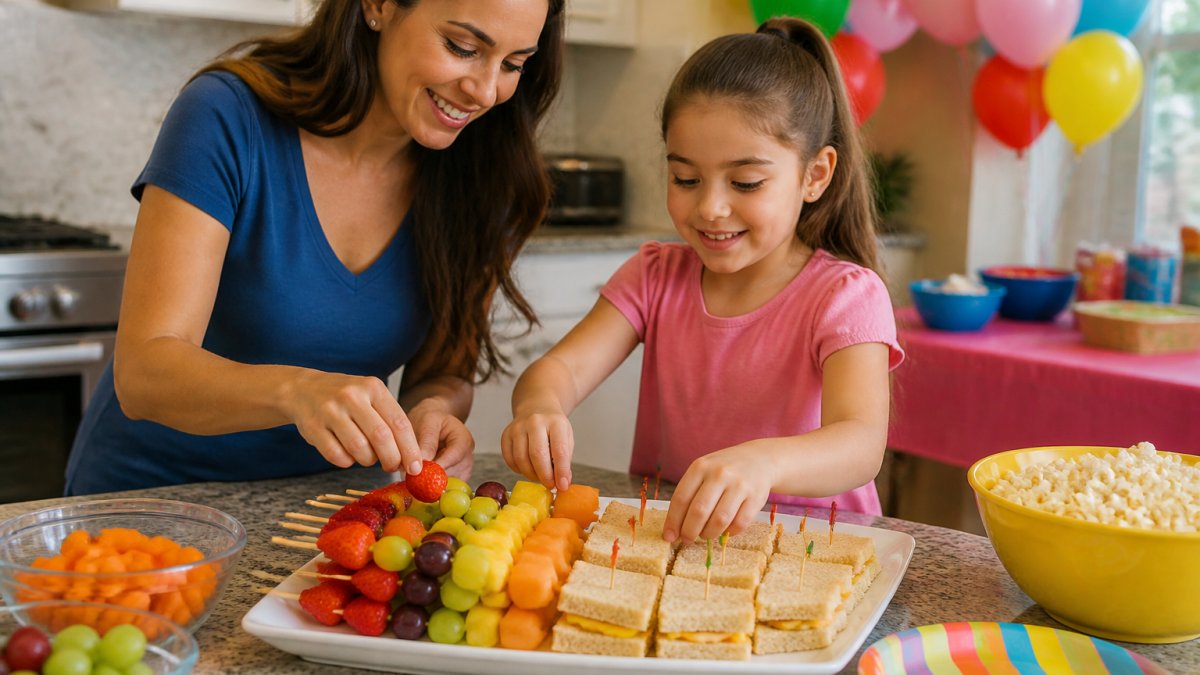
Skip the full meal and serve snacks instead. Most parties fall between meals anyway.
- Mini sandwiches on soft bread
- Fruit skewers with melon and berries
- Homemade popcorn in paper cups
- Veggie sticks with dip
A homemade birthday cake costs far less than a bakery one. A sheet cake or a batch of cupcakes takes an afternoon and saves real money.
Allergy-Aware and Dietary-Inclusive Options
Ask about allergies on the invitation, not at the door. A simple line like “Please let us know about any food allergies” prevents problems.
- Label every dish with what is in it
- Keep nut-free options separate from other foods
- Offer a fruit or veggie option that fits most diets
- Use separate serving utensils for each dish
This is one area where spending a little more is worth it. Every child should be able to eat at the party.
How Long Should a Kids Birthday Party Last?
A kids birthday party should last about two hours for children under 6 and two to three hours for ages 7 and up.
Younger children tire out fast. A two-hour window covers play, food, cake, and goodbyes without meltdowns.
Older kids can handle a longer block, especially if there is one big activity. Add 30 minutes if you are hosting at a venue with open play.
Here is a simple two-hour schedule:
- First 30 minutes: arrival and free play
- Next 30 minutes: games and activities
- Next 20 minutes: food and drinks
- Next 15 minutes: cake and singing
- Last 25 minutes: party bags and pickup
Stick close to this and the party runs itself.
Choosing a Free or Low-Cost Venue: Home, Park, or Indoor Center
The venue choice drives your total cost more than any other decision. Home and public parks are free. Indoor party centers charge for the space but handle setup, cleanup, and entertainment.
| Venue Type | Cost | Best For | Watch Out For |
|---|---|---|---|
| Home | Free | Small groups, toddlers | Space limits, cleanup |
| Public park | Free | Larger groups, warm months | Weather, first come first served picnic tables |
| Indoor play center | Package rate | Any size, any weather | Book early, check what is included |
Public parks often have picnic tables and shade, but they are first come, first served. Send someone early to claim a spot.
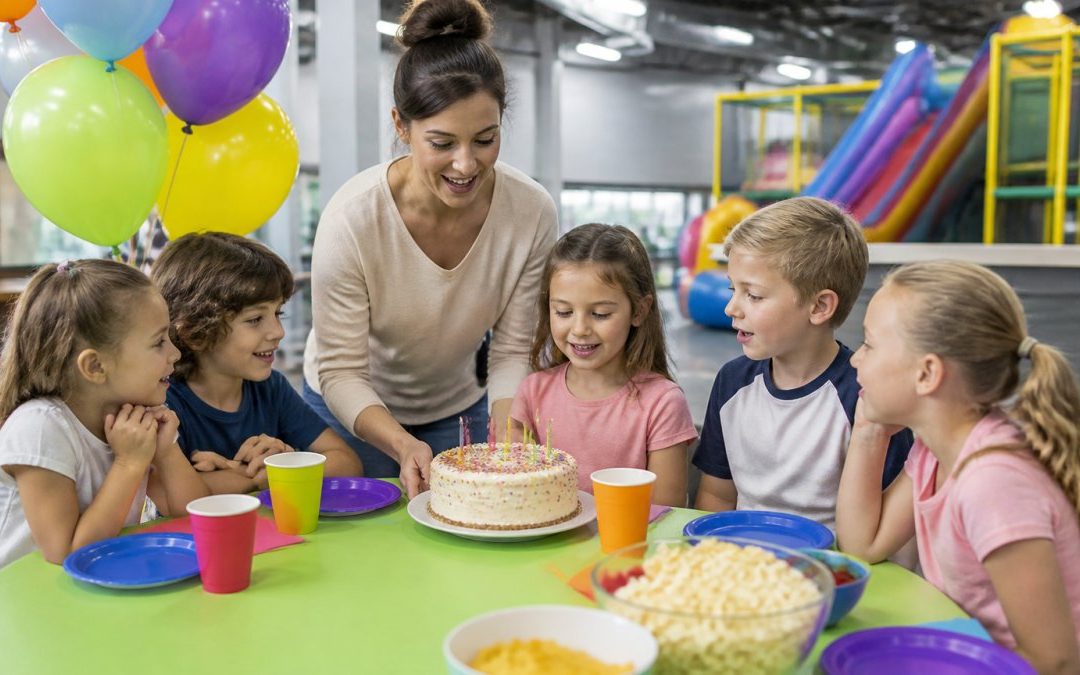
Indoor centers make sense when you want zero setup and a guaranteed rain plan. At Jump Time, our climate-controlled facility near Villa Rica gives kids bounce houses, obstacle courses, inflatable slides, and a toddler soft play area, so the party happens rain or shine.
Rain Plans and Accessibility for Outdoor Parties
Every outdoor party needs a backup plan. Check the forecast three days out and decide then, not the morning of.
- Reserve a pavilion or shelter if the park has one
- Have a home backup ready with a shorter setup
- Tell parents the rain plan on the invitation
- Check that the park has accessible paths and restrooms
- Pick a spot with shade for younger kids and grandparents
If the forecast looks bad, move it indoors. A stressed host makes a stressed party.
Conclusion: Stress Less, Celebrate More
The hardest part of a budget party is trusting that simple is enough. Kids remember the games, the cake, and their friends, not the price of the decorations.
When you want the party handled for you, Jump Time takes the pressure off. Our family-owned indoor play center offers bounce houses, obstacle courses, and a toddler soft play area, all in a clean, climate-controlled space.
Book your party with Jump Time and celebrate without the stress.
Frequently Asked Questions
What’s a good budget for a kids’ birthday party?
A reasonable budget depends on guest count and venue. If you use a free public park and make your own cake, costs can be kept low. For indoor play centers, check their pricing page. Set your budget before planning and track every expense to avoid surprises.
How can I make a kids’ birthday party fun without spending a lot?
Focus on simple activities like freeze dance, obstacle courses, or a scavenger hunt. Borrow or reuse decorations, and host at home or a park. Serve homemade popcorn, fruit skewers, and mini sandwiches instead of catering. A homemade cake and a few dollar-store favors keep costs low while keeping kids happy.
What are inexpensive food ideas for a kids’ party?
Serve mini sandwiches, fruit skewers, homemade popcorn, and veggie sticks with dip. Buy store-brand snacks in bulk and make your own cake or cupcakes. Avoid individually packaged items and pre-cut fruit trays. For drinks, offer water or homemade lemonade in a large dispenser. Always ask about allergies and label dishes clearly.
How long should a kids’ birthday party last?
For toddlers and preschoolers, 1.5 to 2 hours is plenty. Ages 5-8 can handle 2 to 3 hours. Older kids might enjoy 3 to 4 hours for a movie or sleepover. Keep the schedule tight: arrival, play, food, cake, gifts, and goodbye.
Recent Comments