
Last Updated: November 5, 2026
Quick Summary
Plan stress-free kids birthday parties by setting your vision, budget, and guest count first, then booking the venue four to six weeks out. Send invitations three weeks ahead, plan simple age-matched games, and delegate setup and cleanup so you can enjoy the day.
- Set a total budget before spending and log every purchase the day you make it.
- Send invitations two to three weeks ahead with a firm RSVP date and end time.
- Plan about 20 to 30 minutes of structured games, then let kids free-play.
- Serve food about halfway through the party and bring cake out near the end.
- Assign one adult to watch the play area at all times and keep a first-aid kit handy.
Table of Contents
- Start With a Clear Vision and a Manageable Theme
- Set a Realistic Budget and Track Every Expense
- Build Your Guest List and Nail the Kids’ Birthday Party Invitation Wording
- Follow a Kids’ Birthday Party Timeline That Starts Early Enough
- Choose Age-Appropriate Activities and Easy Birthday Party Games for Kids
- Keep Food Simple and Plan Around Dietary Needs
- Use the Kids’ Birthday Party Planning Checklist to Stay on Track
- Book Your Stress-Free Party at Jump Time
- Frequently Asked Questions
Start With a Clear Vision and a Manageable Theme
A stress-free birthday starts with one decision: what kind of party do you actually want? Once you decide whether you want a low-key gathering or a bigger celebration, hosting a stress-free birthday becomes easier because every choice can follow the same plan.
The calmest celebrations usually share the same habit. They pick a clear vision first, then let every other choice follow it.
Here’s the simplest way to set that vision:
- Guest count: a small crew of 8 or a bigger group of 20?
- Energy level: quiet and crafty, or active and loud?
- Location: party at home, a park, or a venue?
Write those five answers down. That’s your party blueprint.
Pick a Theme That Does the Planning for You
A good party theme makes decisions for you. It narrows the cake, the decorations, the games, and the invitations all at once.
A manageable theme is one your child loves and you can execute in a few store trips.
Ask your child one question: “What do you want your party to feel like?” Their answer is usually simpler than you’d guess.
Set a Realistic Budget and Track Every Expense
Most party stress is money stress in disguise. A realistic budget is a total number you decide before you spend a dollar, then a per-category split underneath it. The parents who stay calm are the ones who picked the number first and let the party fit inside it, not the other way around.
Pick Your Total Before You Pick Anything Else
Start with one all-in number you will not cross. A common pattern is to set the total, then subtract the non-negotiables (venue deposit, cake, food) before you allow yourself any spending on decorations or favors.
A workable starting split for a home party:
| Category | Share of Total | What It Covers |
|---|---|---|
| Food and cake | 35-40% | Meal, snacks, drinks, cake |
| Activities and favors | 20-25% | Games, entertainer, favor bags |
| Decorations | 10-15% | Balloons, banners, tableware |
| Extras and buffer | 15-20% | Invitations, thank-yous, backup supplies |
A venue party flips the split: the venue rental takes a larger share, and decorations can drop to a small line item because the space already carries the atmosphere. That trade-off is the real decision.
Compare the Three Real Options
- Home party: lowest cash outlay, highest labor. You absorb setup, cleanup, parking, and weather risk. Best when the guest list is small and the weather is reliable.
- Venue package: higher cash outlay, lowest labor. You trade money for time and a fixed room. Best when the guest list is large or the date falls in a season you can’t count on.
- DIY hybrid: book a bare space or park shelter, bring your own food and games. Middle cost, middle labor, and the most moving parts to coordinate.
Watch out: the venue deposit is usually the single largest sunk cost, so confirm the cancellation and reschedule policy in writing before you pay it. A deposit you can’t recover is a budget problem dressed up as a booking.
Track Every Expense the Day You Make It
Log purchases in a notes app or spreadsheet the same day. The slow leak of small impulse buys, extra favor bags, and “just one more” decoration run is what breaks most budgets.
If cost is your biggest worry, our guide on how to host kids parties on a budget walks through money-saving moves that don’t make the party feel cheap.
Build Your Guest List and Nail the Kids’ Birthday Party Invitation Wording
Guest count drives everything else: food, favors, space, and how many activities you need. Build the list before you book anything.
Start with your child’s must-have friends, then add family and classmates. A practical rule is one guest per year of age for younger kids.
Mixed ages? Our tips on planning birthday parties for mixed ages cover how to keep toddlers and older kids happy at the same event.
Sample Invitation Wording That Gets RSVPs
Clear invitations get fast replies. Vague ones get silence and last-minute texts.
Here’s a template you can copy:
[Child’s name] is turning [age]!
Join us for an afternoon of active play, cake, and fun.
When: [date], [start time] to [end time]
Where: [venue name and address]
RSVP by: [date] to [phone or email]
Please note: [allergy info, dress code, waiver link if needed]
Three details do the heavy lifting:
- A firm RSVP date, at least a week before the party
- The end time, so parents know when to return
- Any waiver or sock requirements, stated up front
Send invitations two to three weeks ahead. Follow up with a short text to anyone who hasn’t replied by the RSVP date.
Follow a Kids’ Birthday Party Timeline That Starts Early Enough
A kids birthday party timeline works backward from the party date. Most parents start too late, then scramble the final week.
Here’s a simple planning timeline by lead time:
- Four to six weeks out: set the vision, budget, guest count, and book the venue
- Three weeks out: send invitations and order the cake
- Two weeks out: plan games, buy decorations and favors
- One week out: confirm RSVPs, finalize the food plan
- Two days out: charge cameras, pack supplies, print your checklist
- Day before: prep food that keeps, set out everything you can
- Party day: delegate setup and enjoy the party
The venue is the piece to lock first. Popular dates disappear fast, especially on weekends.
Choose Age-Appropriate Activities and Easy Birthday Party Games for Kids
The best activities match the kids’ ages, not the theme. Easy birthday party games for kids need little setup and clear rules. But age changes more than the game list, it changes how long the party should run, how many adults you need, and how much structure the kids can handle.
Match Party Length and Supervision to Age
| Age Group | Sweet Spot for Party Length | Adult Supervision | Activity Style |
|---|---|---|---|
| Toddlers (1-3) | 1.5 to 2 hours | One adult per 2-3 kids | Free play, soft areas, short songs |
| Preschool (3-5) | 2 hours | One adult per 4-5 kids | Guided games, parachute, simple crafts |
| Early elementary (5-8) | 2 to 2.5 hours | One adult per 6-8 kids | Relays, treasure hunts, freeze dance |
| Older kids (8-12) | 2.5 to 3 hours | One adult per 8-10 kids | Team challenges, arcade time, minute-to-win-it |
Shorter is almost always better for the youngest guests. A toddler party that runs past two hours turns into meltdown management. Older kids can handle a longer block, but they still need unstructured time to just hang out.
Games That Work by Age
- Toddlers (1-3): soft play areas, stacking blocks, bubbles, a ball pit, pull-string piñatas they can tug without a blindfold
- Preschool (3-5): parachute games, musical chairs, a simple obstacle course, sticker crafts
- Early elementary (5-8): relay races, freeze dance, treasure hunts, pin-the-tail-style games
Plan about 20 to 30 minutes of structured games, then let kids free-play. Over-scheduling is a common mistake. Kids need unstructured time to burn energy, and a packed agenda leaves no room for the party to breathe.
Build a Simple Party Flow
A calm party follows a predictable arc: arrival and free play, then structured games, then food, then cake, then a wind-down. Serve food about halfway through so kids aren’t running on empty, and bring cake out near the end of the party.
Watch out: a game that flops with one age group often works with another, so keep your backups age-matched. Freeze dance rescues a preschool party; older kids may need a team challenge to stay engaged.
Backup Games for When Energy Dips or Plans Fall Through
Every party needs a plan B. Weather ruins outdoor games, and sometimes a game just flops.
Keep three backups ready:
- Freeze dance: music on, dance, music off, freeze. No props needed.
- Balloon volleyball: a balloon and a line on the floor.
- Story circle: a calm reset for tired or overwhelmed kids.
A quiet corner helps too. Kids with sensory needs sometimes need a break from the noise, and a calm space lets them rejoin on their own terms.
Keep Food Simple and Plan Around Dietary Needs
Simple food wins. Familiar foods get eaten, and fancy menus get wasted. Kids birthday parties are not the place for a gourmet spread.
Build a menu around finger foods:
- Pizza or sandwich halves
- Fruit cups and veggie sticks
- Chips or crackers
Ask about dietary needs on the invitation. Note allergies, and label food clearly at the table. Keep one nut-free and one dairy-free option on hand.
Serve food about halfway through the party. Cake comes near the end, after games.
Use the Kids’ Birthday Party Planning Checklist to Stay on Track
A kids’ birthday party planning checklist turns a swirling to-do list into a calm, ordered plan. Print it, tape it to the fridge, and check items off as you go.
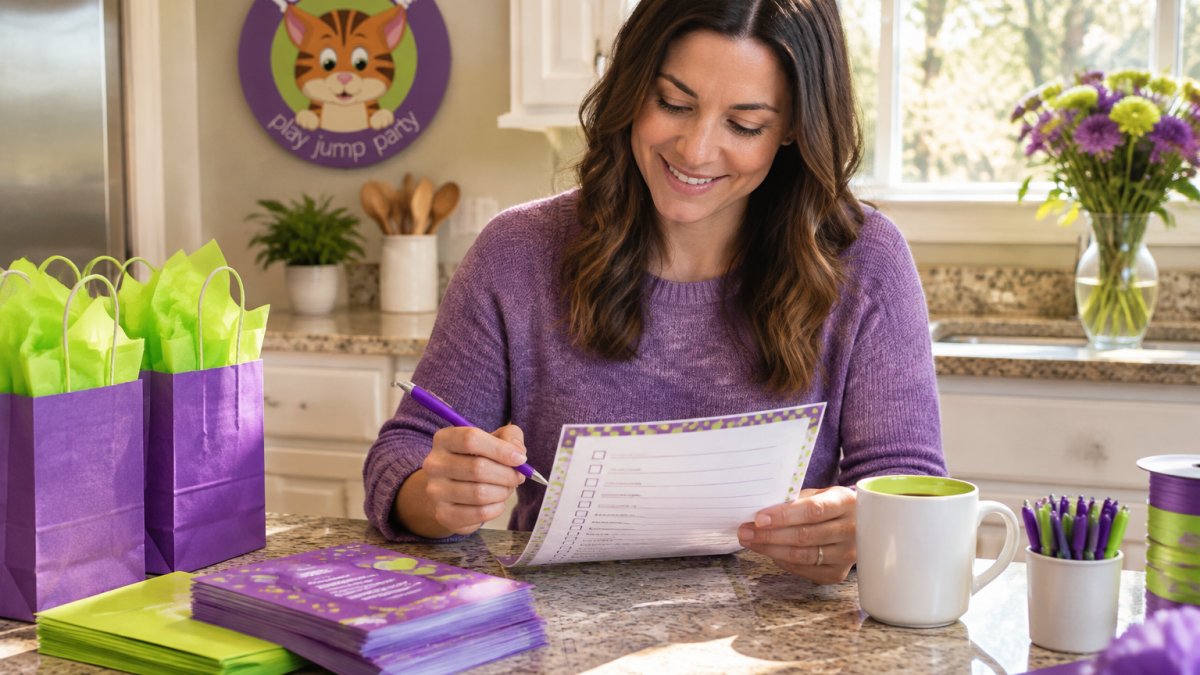
Your checklist should cover:
- Vision, theme, and budget set
- Venue booked and deposit confirmed
- Guest list finalized
Delegate what you can. Ask a friend to handle photos, another to manage the food table, and a third to run games. You’ll actually get to watch your child enjoy the day.
Plan for Safety, Allergies, and Weather Contingencies
Safety planning takes ten minutes and prevents the worst party moments. Confirm allergies before the party, not during cake time.
A few habits that help:
- Ask about allergies on the RSVP and follow up by text
- Keep emergency contact numbers for every guest’s parent
- Set clear rules for play equipment before kids start
Weather can wreck an outdoor plan. Always name an indoor backup before the party day arrives. If you’re booking a venue, ask what the policy is for cancellations and rescheduling.
For venue-specific safety questions, allergy policies, and what to expect on arrival, our FAQ page answers the questions parents ask most.
Book Your Stress-Free Party at Jump Time
You can plan the perfect party yourself, or you can hand the hard parts to a team that hosts celebrations every week.
We’re a family-owned indoor play center built for active, year-round fun, with bounce houses, inflatable slides, obstacle courses, and a toddler soft play area for your youngest guests.
A few reasons families book with us:
- Four party rooms that seat up to 35 guests each
- Online booking and waivers available 24/7, so no phone tag
- Commercial-grade equipment for active play
Ready to stop planning and start celebrating? Explore our parties and events options to see what fits your group, or book your party date online in minutes.
Frequently Asked Questions
How far in advance should you plan a kids birthday party?
Start about four to six weeks ahead for a venue party and three to four weeks for a backyard party. Send invitations three weeks out so families can clear their schedules, and ask for RSVPs two weeks before the date. That window gives you time to adjust the guest count, order cake, and buy supplies without a last-minute scramble.
What should I include in my checklist for planning a birthday party at home?
A practical checklist covers the theme, guest list, invitations, food and cake, drinks, plates and napkins, decorations, games, prizes, goodie bags, and a cleanup plan. Add a column for who is helping with each task so you are not doing everything alone. Two weeks out, confirm the RSVP count and buy non-perishables. The day before, set up tables and prep make-ahead food. On party day, keep the checklist on your phone so you can tick items off as you go.
How long should a kids’ birthday party last?
Two hours works well for toddlers and preschoolers, while kids ages six to ten usually handle two to three hours. Build the schedule around food, cake, games, and free play, and leave buffer time for late arrivals. A common run sheet is 30 minutes of free play, 30 minutes of games, 30 minutes for food and cake, and 30 minutes for presents and goodbyes. Shorter parties reduce meltdowns and make cleanup easier for everyone.
What activities keep children entertained at a birthday party?
Plan a mix of active and quiet options so kids can switch gears. Active choices include obstacle courses, inflatable slides, dance games, and relay races. Quiet choices include craft stations, coloring, and a story corner. Easy birthday party games for kids like freeze dance, balloon relay, and treasure hunt need little setup and work for mixed ages. Always have two backup games ready in case an activity ends early or the group loses interest.
Your child gets one birthday a year, and you get one shot at enjoying it. Pick the venue that handles setup, cleanup, and the chaos so you can be a guest at your own party. Get started with Jump Time and give your family a celebration that feels easy from the first invitation to the last slice of cake.

Recent Comments