
Last Updated: November 7, 2026
Quick Summary
Local play venues are family-run indoor play centers serving one neighborhood or town, and many families find them better because the trip is shorter and the crowds are smaller. Shorter drives give back time to your kids, and smaller venues are easier to supervise from one spot.
- A 40-minute drive each way plus parking eats an hour and a half of a four-hour window.
- Smaller venues tend to feel less crowded, with shorter lines for inflatable slides.
- Walk the floor before paying to check padding, cleanliness, visible staff, and gated exits.
- Two hours is plenty for most kids under six, while older kids stretch to three.
- Ask a venue for the all-in number for your family size rather than comparing entry fees alone.
Table of Contents
- Why Local Play Venues Beat Bigger Chains for a Family Day Out
- The Benefits of Active Play for Children Go Beyond Burning Energy
- An Indoor Play Center Safety Checklist Every Parent Should Use
- Finding the Right Indoor Playground for Toddlers and Older Kids
- Comparing Costs: What a Local Family Outing Actually Includes
- Picking a Birthday Party Venue for Kids Without the Guesswork
- How Local Play Venues Strengthen the Community
- Book Your Next Family Outing at Jump Time
- Frequently Asked Questions
Why Local Play Venues Beat Bigger Chains for a Family Day Out
Local play venues are family-run indoor play centers that serve one neighborhood or town, and many families find them more convenient because the trip is shorter and the crowds are smaller. At Jump Time, we hear the same thing from parents every week: the big-name places look impressive online, then eat up an entire Saturday. Below, we break down what a local venue gets right, plus a safety checklist, age-by-age planning tips, and a cost breakdown you can use before you spend a dime.
Shorter Drives, Lower Stress, More Time Playing
The math on a family outing is brutal. A 40-minute drive each way plus parking eats an hour and a half of a four-hour window.
That matters more than it sounds. Short trips mean fewer meltdowns in the car, fewer bathroom emergencies on the highway, and a real chance of getting home before nap time collapses.
There’s also the escape hatch. If your toddler melts down 20 minutes in, you’re home fast. At a chain an hour away, you’re stuck.
Smaller Crowds and Easier Supervision
Larger venues often draw bigger crowds, and smaller venues tend to feel less crowded when you walk in.
- You can see all your kids from one spot
- Lines for the inflatable slides stay short
- Restrooms and exits are easy to keep in view
- Staff recognize repeat visitors and their kids
A common mistake parents make is judging a venue by square footage. More space usually means more kids, more noise, and more ground to cover. For a parent alone with two children, a smaller floor plan is a feature, not a limitation.
The Benefits of Active Play for Children Go Beyond Burning Energy
Active play is unstructured physical movement, like climbing, jumping, and crawling, and its benefits reach well past fitness. The CDC’s guidance on physical activity for children notes that regular movement supports bone strength, heart health, and healthy weight in kids. If you want the full picture, our team wrote a deeper guide on the benefits of active play for young children.
What Active Play Builds: Coordination, Confidence, and Social Skills
Watch a child work up the nerve to climb an inflatable slide. That’s balance, grip strength, and spatial awareness in one move. Then there’s the social layer.
- Taking turns on equipment
- Asking another kid to play
- Handling a small disappointment without falling apart
- Trying a harder obstacle after a failed attempt
These are the skills kids carry into school. A play center gives them a low-stakes place to practice, with you nearby.
An Indoor Play Center Safety Checklist Every Parent Should Use
An indoor play center safety checklist is a short list of things to look at before you pay: padding, cleanliness, supervision, exits, and equipment condition.
What to Check Before You Pay
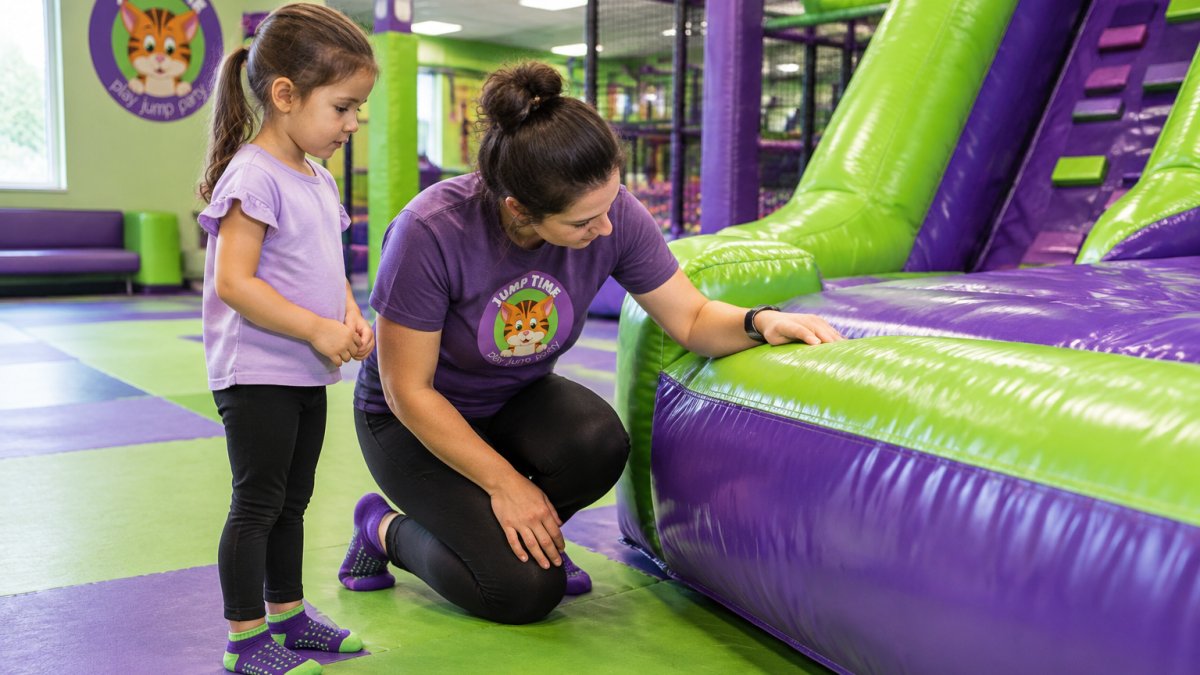
Walk the floor before your kids disappear into it. Five minutes tells you plenty.
- Padding covers every hard edge, with no gaps or loose seams
- Equipment looks clean, dry, and free of tears or tape patches
- Staff are visible on the floor, not just at the front desk
- Entry and exit points are gated and watched
- A posted cleaning routine exists, not just a sign that says “clean”
Cleanliness deserves its own moment. We wrote a full breakdown on how often indoor play centers should be cleaned if you want the standards to compare against.
Watch out: a venue that can’t answer a cleaning question on the spot may not have a clear routine.
Finding the Right Indoor Playground for Toddlers and Older Kids
The right indoor playground for toddlers is one with a dedicated soft play area, low equipment, and clear sightlines, while older kids need bigger obstacles and room to run. Mixing ages on the same equipment is where injuries and frustration happen.
If you have a toddler, start with a venue page built around toddler indoor playgrounds so you know what’s actually set aside for little ones.
Age-by-Age Planning Tips
Match the visit to the kid, not the other way around.
| Age Group | What to Look For | Visit Timing |
|---|---|---|
| Under 3 | Soft play area, low slides, padded flooring | Mornings, quieter weekdays |
| Ages 3-5 | Small inflatables, obstacle courses, close supervision | Early slots before crowds build |
| Ages 6-8 | Bigger slides, climbing structures, open floor space | Any open play session |
| Ages 9+ | Arcade, group challenges, room to move | Afternoon or weekend blocks |
Two hours is plenty for most kids under six. Older kids will happily stretch to three.
Comparing Costs: What a Local Family Outing Actually Includes
A local family outing usually costs less than a trip to a larger attraction once you count gas, parking, food, and the add-ons bigger venues charge for. Entry is only part of the total, and the venue that looks cheaper on the admission line can end up costing more by the time you get home. Comparing the full cost of an outing can also help families decide whether family friendly venues with live music make a better fit for dinner than another paid attraction.
Here is what to add up before you compare two venues:
- Entry for each child and adult, including whether non-playing adults pay
- Gas and tolls for the round trip
- Parking fees, or free lot versus paid garage
- Food and drinks, or a packed lunch and outside-food policy
- Arcade cards, grip socks, or other extras
The Line Items That Quietly Change the Total
Admission is the number parents see first, but it is rarely the number that decides the day.
Food policy. Ask about the food policy before you book, including whether outside food is allowed, so you can plan lunch.
Add-ons. Extras such as arcade cards and grip socks can add to the total, so ask what is included in the entry price.
How Local Venues Usually Compare
Entry prices and what they include vary from venue to venue, so compare the full total for your visit.
A practical way to compare is to build a rough total for your actual family: two adults, two kids, one meal, one arcade stop. Run the same math for each venue you are considering. The one with the lower total for your real group is the better value, regardless of which has the lower headline admission.
Ask any venue for the all-in number for your family size, including food and add-ons, and compare that rather than the entry fee alone.
For a fuller picture of what venues charge and what is included, our indoor playground prices guide breaks down the categories.
Picking a Birthday Party Venue for Kids Without the Guesswork
A good birthday party venue for kids handles setup, food, and cleanup so parents can actually enjoy the party. The best way to judge one is to ask direct questions before you commit.
Questions to Ask Before You Put Down a Deposit
Bring this list to every tour. Vague answers are your signal to keep looking.
- How many party rooms do you have, and how many guests fit in each?
- Is setup and cleanup included, or extra?
- Can we bring our own cake and snacks?
- How do you separate party groups from open play?
- What’s the deposit, and what’s the cancellation policy?
That last one matters. Ask about staff training and incident procedures in plain terms. When you’re ready to compare packages, the parties and events page lays out what’s available.
How Local Play Venues Strengthen the Community
Local play venues function as a neighborhood hub, and the effect is concrete rather than sentimental. Families often return to the same venues, and parents may swap recommendations while their kids play.
That is the part larger chains cannot easily copy. A local venue’s staff live nearby, its owner knows the regulars by name, and its success depends on repeat visits rather than one-time tourists.
What Repeat Visits Actually Build
A local venue gives families a low-stakes social loop that bigger attractions do not. Three things tend to follow:
- Recognizable faces. Kids see the same children across visits, which makes it easier to join a game rather than start from zero each time.
- Parent networks. Adults trade school, camp, and babysitter recommendations while their kids play, which is hard to do at a venue you visit once a year.
- Comfort with the space. A child who knows the floor plan moves with more confidence, tries harder equipment, and needs less supervision over time.
The Local Ownership Difference
Locally owned businesses are often rooted in their communities, which can benefit the neighborhood over time.
There is also a practical accountability angle. When the owner lives in the same town as the customers, complaints reach a decision-maker directly.
Watch out: “local” is a label any venue can print on a sign. Ask who owns it and whether the same staff are there across visits.
Supporting a local venue is not charity.
Book Your Next Family Outing at Jump Time
The hardest part of a family outing is picking a place you can trust with your kids for three hours. Jump Time is family owned and operated, with a climate-controlled indoor facility featuring bounce houses, obstacle courses, inflatable slides, an indoor play structure, and a toddler soft play area. Our commercial-grade equipment and party rooms make birthdays easy, and online waivers plus 24/7 booking let you plan your visit at any time. Get started with Jump Time and turn a rainy afternoon into the outing your kids ask about all week.
Frequently Asked Questions
What are the benefits of taking children to a local play venue?
Local play venues give children a safe, climate-controlled space to run, climb, and slide, which supports coordination, confidence, and social skills. Parents may find shorter drives and smaller crowds more convenient than at larger venues. Some venues offer toddler-only areas, party rooms, and online booking, which can make planning simpler.
How do I choose a family-friendly indoor play center?
Start with an indoor play center safety checklist: look for padded surfaces, visible staff supervision, posted cleaning routines, and clear rules for each play zone. Check whether the venue separates toddlers from bigger kids, confirm restrooms and a quiet area are available, and ask how booking and waivers work. Read recent reviews for cleanliness and crowd levels, then visit at a quieter time to see how the space feels before committing to a party.
Are local play venues suitable for toddlers and older children together?
Many are, as long as the venue separates age groups. Look for a dedicated toddler soft play area with low slides and soft blocks, plus a larger structure for kids ages five and up. If you are planning a mixed-age birthday party, ask whether the venue can section off spaces or schedule times so toddlers are not overwhelmed. A good indoor playground for toddlers will also post height and age limits at each zone.
How can parents check whether an indoor play venue is clean and safe?
Ask how often equipment is cleaned, especially inflatables and high-touch surfaces after parties. Look for hand-sanitizing stations, visible staff, and posted safety rules. Check that inflatables are anchored and padded, that exits are gated, and that waivers are handled online before arrival. Reading recent reviews and visiting during a quiet hour gives you a clear picture of cleanliness and supervision before you book a birthday party venue for kids.

Recent Comments